
Aegis Ledger
A financial-operations control system for reviewing sensitive account activity with an attributable audit trail and independent decision points.
Local engineering build · synthetic demonstration data
- 14API / domain tests
- Locally verified .NET behaviour
- 5frontend tests
- Console workflow evidence
- 4browser checks
- Desktop and mobile checkpoint
- 5policy-controlled roles
- JWT bearer authentication
Why this build.
Aegis Ledger is a locally verified graduate-programme evidence build for banking, investment and technology roles. It makes financial-operations constraints visible: permissions, traceability, review and testability.
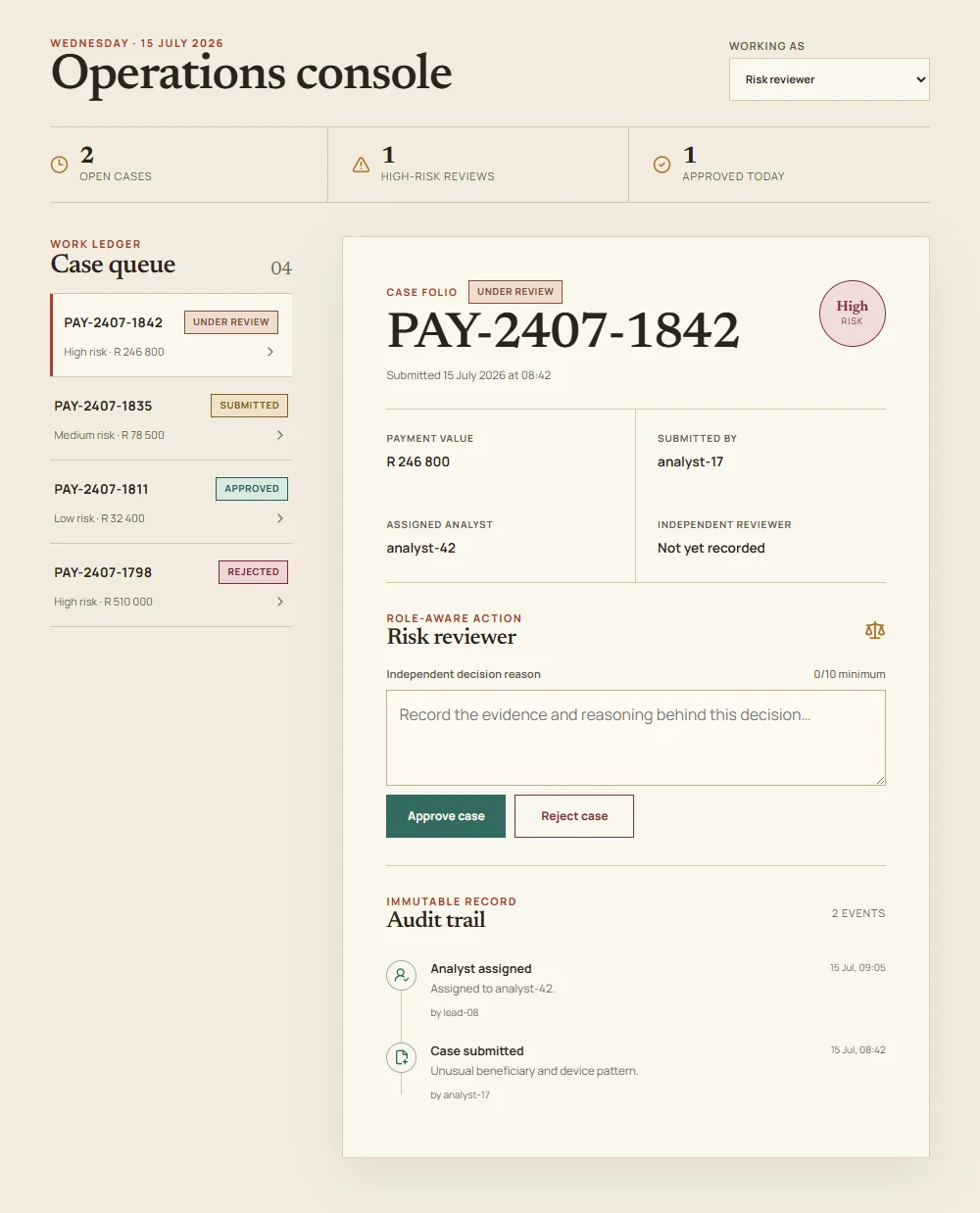
The API and operations console exist locally. The evidence includes domain and HTTP integration tests, frontend workflow tests, responsive browser checks, a PostgreSQL migration and a Linux container. It remains a portfolio build, not a production banking system.
Keep the decision attributable.
The domain separates the maker, analyst and independent reviewer. Accepted case transitions leave an append-only audit event, so the reason and responsible identity can be inspected together.
Separate the decision. Keep the history.
- Maker
- Analyst
- Independent reviewer
Accepted transition → append-only audit event
Build sequence
- Implemented
.NET 10 LTS API, PostgreSQL schema and first migration.
- Implemented
React and TypeScript console with role-aware assignment and decisions.
- Next
Authorised queue API, concurrency control and PostgreSQL integration tests.
The stack and the reason.
The .NET and React stack was selected from target-employer evidence. Each milestone is supported by setup notes, a schema decision, test output and a focused demonstration.
- .NET 10 LTS
- Domain rules and HTTP API boundaries for case operations.
- JWT bearer policies
- Five policy-controlled roles and attributable actions.
- PostgreSQL
- Checked-in schema and first migration.
- React + TypeScript
- A role-aware local console for assignment and review.
- Linux container
- A reproducible local runtime boundary.
Implemented boundaries.
Identity and permissions
JWT bearer authentication and five policy-controlled roles.
Operational audit trail
Append-only events for every accepted case transition.
Risk review
Domain-enforced separation between maker, analyst and reviewer.
Delivery discipline
Fourteen API/domain tests, five frontend tests and four browser checks.
The evidence checkpoint.
The .NET domain/API checks, frontend workflow tests, responsive captures and PostgreSQL migration provide local evidence at their recorded checkpoints. The retained image shows the local synthetic adapter rather than a live banking connection.
- The repository stays unpublished until its setup, API/UI boundary and remaining limitations are ready for independent review.
- Authorised queue access, concurrency control and PostgreSQL integration tests remain the next implementation slice.
- Working locally; deliberately not presented as deployed, public or production-ready.
This case study is kept outside search indexing. The repository is local, and these checkpoints establish local behaviour.